


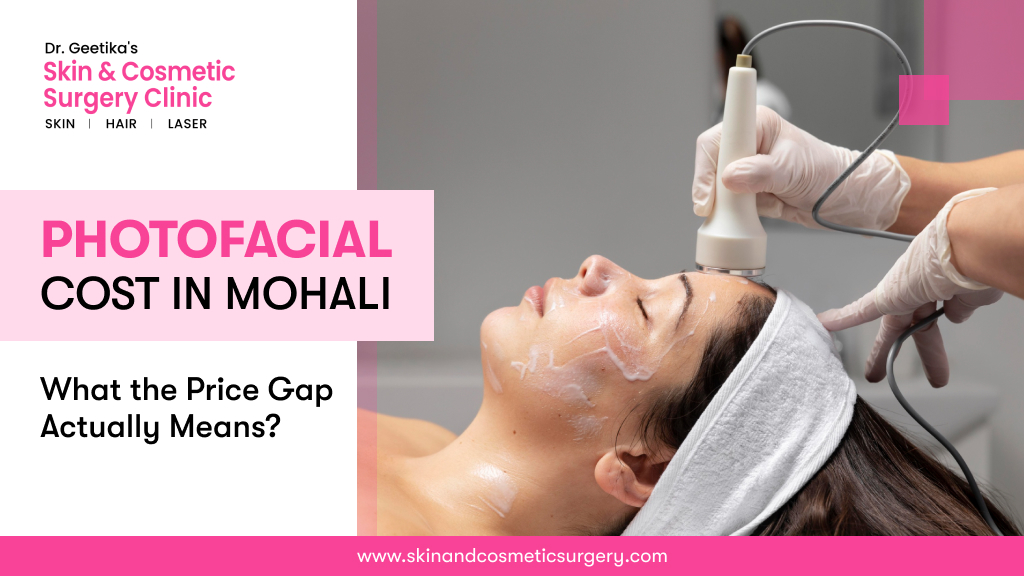
One clinic quotes ₹2,000. Another quotes ₹7,000 for the same treatment.
At first glance, it feels overpriced. Until you realise the treatment itself may not be the same at all.
The machine, the expertise behind it, the safety protocols, and the way your skin is assessed can completely change both the outcome and the risk involved.
For Indian skin tones, especially in Mohali’s harsh summer climate, those differences matter more than most people realise.
Here’s what actually drives the cost of photofacial in Mohali, and what you should know before booking a session.
Why Is There Such a Big Price Difference?
The machine matters. So does the person using it.
Photofacial prices across India fall between ₹1,500 and ₹8,000 per session. That spread isn’t about location or interior design. It comes down to equipment grade, clinical setting, and expertise.
A salon charging ₹1,500 is almost always running a consumer-grade IPL device. Low-powered. Not built for clinical precision.
A dermatology clinic at ₹5,000 to ₹7,000 is using a medical-grade system. Settings calibrated for your skin tone. Your concern. The exact depth of pigmentation being treated.
Not equivalent. Results won’t be either.
What Are You Actually Paying For?
Here’s the honest breakdown.
The machine
Medical-grade IPL delivers precise wavelengths of light. Settings are adjusted for your skin tone, pigmentation depth, and treatment area.
Consumer devices can’t match that. Output becomes inconsistent. That leads to patchy results. Sometimes worse, actual skin reactions.
The consultation
A proper skin assessment before IPL is not optional. Your skin type, melanin level, sun exposure, medications, active breakouts. All of this changes how the settings should be configured.
A dermatologist goes through every one of these before starting. A walk-in salon appointment usually skips most of it.
Who’s actually behind the machine
IPL is not plug and play. Settings need to match each patient. Sometimes they need to change mid-session based on how the skin is reacting.
Wrong settings cause burns. Post-inflammatory hyperpigmentation. Or simply no results. This becomes a bigger risk with Indian skin tones, which brings us to the next point.
Is Budget IPL Safe for Indian Skin?
Most beauty promotions won’t mention this. But it’s worth knowing.
IPL was originally developed and tested on lighter, Western skin tones. Indian skin carries more melanin. It absorbs light energy differently. A setting that works safely on a fair complexion can cause real damage on a medium or deeper Indian skin tone.
Burns. Uneven pigmentation. New dark patches caused by the treatment itself. These are known risks when IPL is poorly calibrated for higher-melanin skin.
Mohali’s summers add to this. Intense UV exposure from April through August means patients often come in with active tanning or sun-damaged skin. That changes what a safe, effective session looks like. A standard treatment copied off a menu isn’t the right approach.
At Dr. Geetika Skin & Cosmetic Surgery Clinic, photofacial treatments are supervised by Dr. Geetika Paul, a dermatologist with over 10 years of experience working with Indian skin tones across the Tricity region. Every patient is assessed individually. No two treatment plans are the same.
That assessment step is something to ask about anywhere you consider booking.
What Actually Makes the Price Go Up or Down?
When comparing photofacial in Mohali, Chandigarh, Panchkula, or Zirakpur, these are the real factors behind the numbers.
Equipment grade
Medical-grade IPL systems cost more to buy, run, and service. That gets reflected in pricing. Not as markup. As operating cost.
Dermatologist involvement
This one changes everything. A dermatologist brings clinical judgment. They catch contraindications before they become problems. They adjust settings based on how your skin actually responds in the session.
Treatment area
A full face costs more than just the cheeks. Add the neck or décolletage and the price increases further. Some clinics price by zone. Others price by session. Worth asking before you book.
Number of sessions
A package priced upfront may look like a lot at first. But it nearly always works out cheaper than booking single sessions at different places. And results build across sessions. That’s how IPL works.
Aftercare support
Your skin is in repair mode after IPL. It needs proper protection, especially in Mohali’s heat. Walking out without aftercare guidance can undo your results within days.
How Many Sessions Do You Need?
Depending on the condition you are treating.
For mild tanning or early-stage pigmentation, two to three sessions are typically sufficient to notice a significant improvement.
Four to six treatments spaced three to four weeks apart are recommended for deeper pigmentation, older acne marks, and years of uneven tone.
Anyone who promises significant outcomes in a single session should be given another chance. IPL results are cumulative. The skin keeps improving even weeks after a full course ends. That’s worth factoring in from the start.
Salon IPL vs Clinic IPL: Is the Difference Real?
Yes. Often a significant one.
Salons use the word “photofacial” freely. The term isn’t regulated. Device standards aren’t standardised. The person operating the machine may have done a short certification course, nothing more.
That doesn’t automatically mean bad results every time. But it means assuming both are equal just because the name matches is a mistake.
If you’re considering photofacial in Mohali for a real skin concern, pigmentation before a wedding, summer sun damage, years of uneven tone, the more careful choice is a clinic where you’re assessed as a patient.
What to Avoid After Treatment in Mohali’s Heat
Post-treatment care is where a lot of people quietly lose their results. Particularly in a city where summer sun hits hard.
After IPL, your skin is in active repair mode. Treated areas may look slightly darker before they clear. That’s the pigment breaking down and rising to the surface. Normal. But the skin is also more sensitive than usual during this period.
For at least one week after each session, avoid:
- Sun exposure without SPF 50+ properly applied
- Swimming pools or steam rooms
- Scrubs, exfoliating acids, or retinol products
- Very hot water on the face
- Makeup within the first 24 hours
Your clinic should cover all of this before you leave. If they don’t bring it up, ask for it directly.
How to Choose the Right Clinic in Mohali
Whether you choose Dr. Geetika’s clinic or elsewhere, check for these things:
- A qualified dermatologist involved in your treatment plan, not just the initial consult
- Medical-grade IPL equipment confirmed before booking
- Individual skin assessment done before treatment begins
- Honest guidance on how many sessions your concern actually needs
- Clear aftercare instructions that account for Mohali’s climate
The best photofacial clinic in Mohali is not the cheapest one. It’s the one that treats your skin as a clinical case, not a line item.
Dr. Geetika Skin & Cosmetic Surgery Clinic is at SCF 31, Phase 10, Mohali. Patients come from Chandigarh, Panchkula, Zirakpur, Kharar, and across the Tricity region.
Start With a Consultation
There is no need to make an upfront commitment.
If you’re thinking about getting a photofacial in Mohali to treat pigmentation, UV damage, uneven skin tone, or acne blemishes, you need first have a complete skin examination. Dr. Geetika Paul will honestly examine your skin, explain what to expect, and provide a detailed breakdown of sessions and costs.
Schedule an appointment with our team before making any decisions.
Frequently Asked Questions
Q1. Is photofacial safe for Indian skin?
Ans. Yes, provided that the procedure is carried out by a licensed dermatologist using medical-grade IPL. Because Indian skin contains more melanin, settings need to be changed. It works well on most skin tones and is safe when used properly.
Q2. How much does photofacial in Mohali cost?
Ans. Each session costs between ₹1,500 and ₹8,000. The range represents actual variations in treatment area, clinical skill, equipment quality, and aftercare. Less clinical oversight or consumer-grade gadgets are typically indicated by lower pricing.
Q3. How many sessions will I need?
Ans. The majority of individuals require three to six sessions spaced three to four weeks apart. Mild pigmentation could go away more quickly. The entire course is usually required for deeper issues like chronic uneven tone or previous acne blemishes.
Q4. Can photofacial reduce pigmentation?
Ans. Yes. IPL breaks down excess melanin from sun exposure, hormonal changes, or acne. Results build across sessions. Very deep pigmentation may need additional treatments used alongside IPL.
Q5. What should I avoid after a photofacial?
Ans. Sun exposure without SPF 50+, swimming pools, steam rooms, exfoliating treatments, retinol, and active acids should all be avoided for at least a week. Before you leave the clinic, your dermatologist should give you a comprehensive list of aftercare.
Q6. Is photofacial better than HydraFacial?
Ans. They work differently. Photofacial targets pigmentation and sun damage beneath the surface. HydraFacial cleanses, exfoliates, and hydrates at the surface level. Some patients benefit from both. A dermatologist can advise which suits your specific concern.