

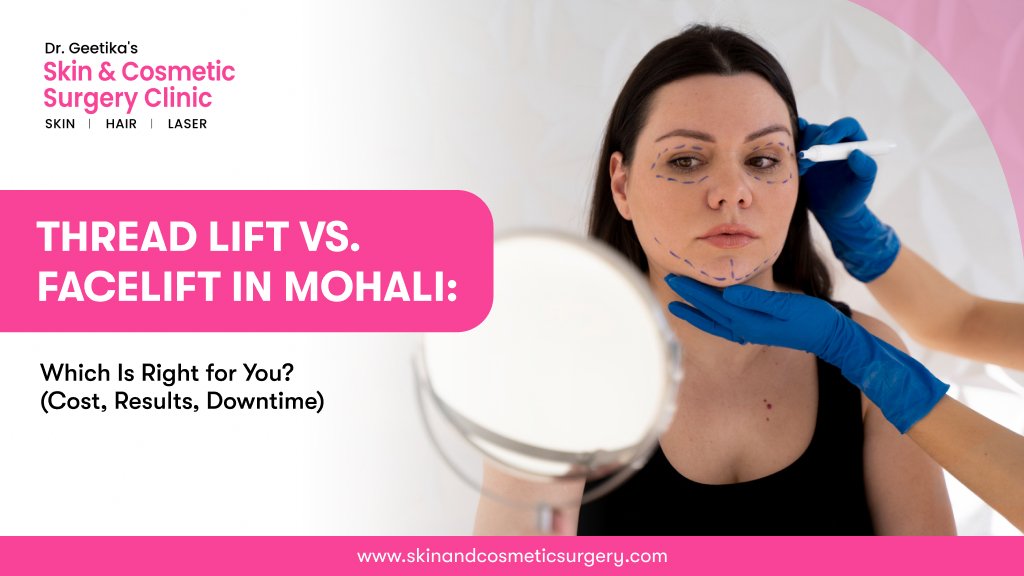
Early signs of aging often show up in small ways: a softening jawline, deeper smile lines, or a slight looseness around the cheeks. When that happens, most people want a solution that restores their natural facial structure without making them look “done.”
In the Chandigarh Tricity region (Mohali, Chandigarh, and Panchkula), anti-aging treatments have evolved rapidly, and patients no longer have to choose blindly between minimal-effect cosmetic treatments and major surgery. Today, two options dominate facial rejuvenation: surgical facelifts and, for those seeking a less invasive route, a thread lift in Mohali.
Both address facial sagging, but they differ significantly in how they work, what they cost, how long recovery takes, and how long results last. The right choice depends on your age, skin elasticity, and daily schedule, and choosing well is what prevents disappointing outcomes. This guide breaks down each option so you can decide with confidence.
Thread Lift vs. Facelift: What Is the Difference?
To make an informed choice, you must understand the underlying structural mechanics of both procedures.
The Thread Lift (Non-Surgical Mechanical Suspension)
A thread lift is a minimally invasive, in-clinic procedure performed under local anesthesia. Medical-grade, dissolvable sutures equipped with tiny barbs or cogs (typically made of Polydioxanone/PDO, PLLA, or PCL) are inserted into the subcutaneous layer of the skin using fine cannulas.
Once placed, these threads are gently pulled to physically anchor and suspend sagging skin. Over the next 6 to 12 months, as the threads naturally dissolve, they stimulate localized collagen and elastin production along the insertion tracks.
- What it does: Tugs and suspends superficial tissue while stimulating collagen.
- What it does NOT do: It does not alter deep muscle layers or remove stretched, excess skin.
The Surgical Facelift (Deep-Plane or SMAS Repositioning)
A surgical facelift (rhytidectomy) is a full surgical operation performed under deep sedation or general anesthesia. Instead of just pulling the top skin layer, a plastic surgeon works beneath the surface to lift, tighten, and reposition the SMAS (Superficial Musculoaponeurotic System), the foundational muscle and tissue layer that controls facial contour.
Once the underlying structural frame is elevated to its youthful position, any loose, excess skin is trimmed away before the incisions around the ear line are closed with micro-sutures.
- What it does: Reorganizes deep muscle structures, lifts sagging fat pads, trims loose skin, and restores a firm jawline and neck contours.
- What it does NOT do: It does not change surface skin texture, pigmentation, or fine wrinkles (which are better addressed with lasers or skin boosters).
Threadlift vs. Facelift in Mohali: Cost, Downtime, and Results Compared
| Feature | Non-Surgical Thread Lift | Surgical Facelift |
| Primary Goal | Subtle lift & early collagen boost | Complete structural overhaul & skin removal |
| Anesthesia Type | Local anesthesia (numbing injection) | General anesthesia or local with heavy sedation |
| Procedure Duration | 45 to 60 minutes | 3 to 5 hours |
| Downtime / Recovery | 2 to 4 days (minor swelling/bruising) | 10 to 21 days (bandages, bruising, rest) |
| Longevity of Results | 12 to 24 months | 10 to 15 years |
| Average Cost in Tricity | ₹30,000 – ₹80,000 (varies by thread count) | ₹1,50,000 – ₹3,50,000+ (clinic/surgeon dependent) |
Downtime and Daily Life in Tricity
When deciding on facial treatments, local climate and daily routines matter just as much as medical specs.
Recovery After a Thread Lift
Thread lifts cause minimal disruption to your daily routine. Because there are no surgical incisions, only tiny pinhole entry points near the hairline or temples, healing is speedy.
- First 48 Hours: Expect slight tightness, mild swelling, and occasional small bruises.
- Work & Social Life: Most patients in Mohali and Chandigarh resume normal desk jobs or routine errands within 24 to 48 hours.
- Climate Precautions: During hot and humid North Indian summer months, keep the tiny entry points clean to prevent localized bacterial infection from sweat. Avoid heavy gym workouts, facial massages, or sleeping on your side for 2 weeks to keep the barbed anchors from dislodging.
Recovery After a Surgical Facelift
Choosing a surgical facelift Mohali requires a planned pause from public life and physical exertion.
- First 1 to 2 Weeks: You will wear supportive facial bandages for the first few days to manage surgical swelling and fluid retention. Bruising around the lower jaw and neck peaks around day 4 and fades over 14 days. Stitches are typically removed between days 7 and 10.
- Work & Social Life: Plan for 2 full weeks off from work and high-profile social commitments.
- Climate Precautions: Managing surgical incisions in peak summer heat demands care. Clean, air-conditioned indoor recovery is critical to prevent sweat accumulation along incision sites behind the ears. Avoid direct sun exposure for several weeks to prevent hyperpigmentation along healing scars.
Which Procedure Is Right for You?
You are an Ideal Candidate for a Thread Lift if:
- Age Range: Late 30s to late 40s.
- Skin Condition: You have mild-to-moderate skin laxity with early softening along the jawline or minor deepening of nasolabial folds (smile lines).
- Skin Elasticity: Your skin still possesses good natural snap-back elasticity.
- Schedule: You cannot afford 2 weeks of surgical downtime due to work, family commitments, or upcoming events.
- Goal: You want a subtle, refreshed look without undergoing surgery or altering your fundamental facial features.
You are an Ideal Candidate for a Surgical Facelift if:
- Age Range: Late 40s, 50s, 60s, and beyond.
- Skin Condition: You have prominent jowls, significant skin sagging along the lower face, deep structural folds, or heavy, loose skin around the neck (“turkey neck”).
- Skin Elasticity: There is noticeable tissue stretch and skin excess that cannot be pulled tight without cutting away the slack.
- Schedule: You can set aside 2 to 3 weeks for complete, undisturbed recovery.
- Goal: You want a dramatic, long-lasting transformation that sets back the clock by a decade or more.
Take the Next Step Toward Your Best Self with Dr. Geetika
Choosing between a thread lift and a facelift in Mohali comes down to your personal goals, skin condition, and lifestyle. As one of the Tricity’s leading dermatologists and cosmetic specialists, Dr. Geetika Paul, the best plastic surgeon in Mohali, provides honest, expert guidance tailored to your unique facial anatomy. Whether you need subtle youth restoration or a complete structural transformation, Dr. Geetika and her skilled team prioritize safety, precision, and natural-looking results.
Ready to refresh your appearance? Schedule your personalized consultation today and experience world-class aesthetic care in Mohali.
Frequently Asked Questions (FAQs)
Q1. Can a thread lift replace a surgical facelift?
Ans. No. A thread lift cannot replace a surgical facelift because it works on a different anatomical layer and does not remove excess skin. Think of a thread lift as a temporary hold that suspends superficial tissue, whereas a facelift reorganizes deep muscle structures and trims away slack skin. If you have significant sagging, threads will not deliver the outcome you desire.
Q2. Is a thread lift painful?
Ans. Pain is minimal. The clinic applies topical numbing cream followed by local anesthesia injections along the thread tracks. You will feel pressure and a slight tugging sensation during the procedure, but no sharp pain. After the anesthesia wears off, mild soreness or tenderness when chewing or smiling may last for 3 to 5 days, which is easily managed with routine pain relievers.
Q3. Which option is more cost-effective in the long run?
Ans. While a threadlift in Mohali has a much lower upfront cost (₹30,000 – ₹80,000) compared to a facelift (₹1,50,000 – ₹3,50,000+), thread results fade after 12 to 24 months. If you repeat thread lifts every 1.5 years over a decade, your cumulative financial cost will approach the cost of a one-time surgical facelift. A facelift offers higher long-term financial value for severe aging, while threads are cost-effective for early maintenance.
Q4. Will a surgical facelift make my face look artificial?
Ans. Not when performed by a skilled plastic surgeon. The “pulled” look of older facelifts happened because surgeons only pulled and stretched the outer skin tight. Modern facelift techniques focus on lifting the deep SMAS muscle layer vertically. Once the underlying foundation is secure, the outer skin is redraped naturally without tension, leaving a refreshed, youthful, and soft appearance.
Q5. Can I combine a thread lift or facelift with other aesthetic treatments?
Ans. Yes, and combination therapy often yields the best outcomes. A thread lift or facelift, corrects structural position and sagging, but neither stops surface aging. Combining your procedure with treatments like HydraFacials, RF skin tightening, Botox for expression lines, or laser treatments for pigmentation ensures both structural firmness and skin quality are addressed.